

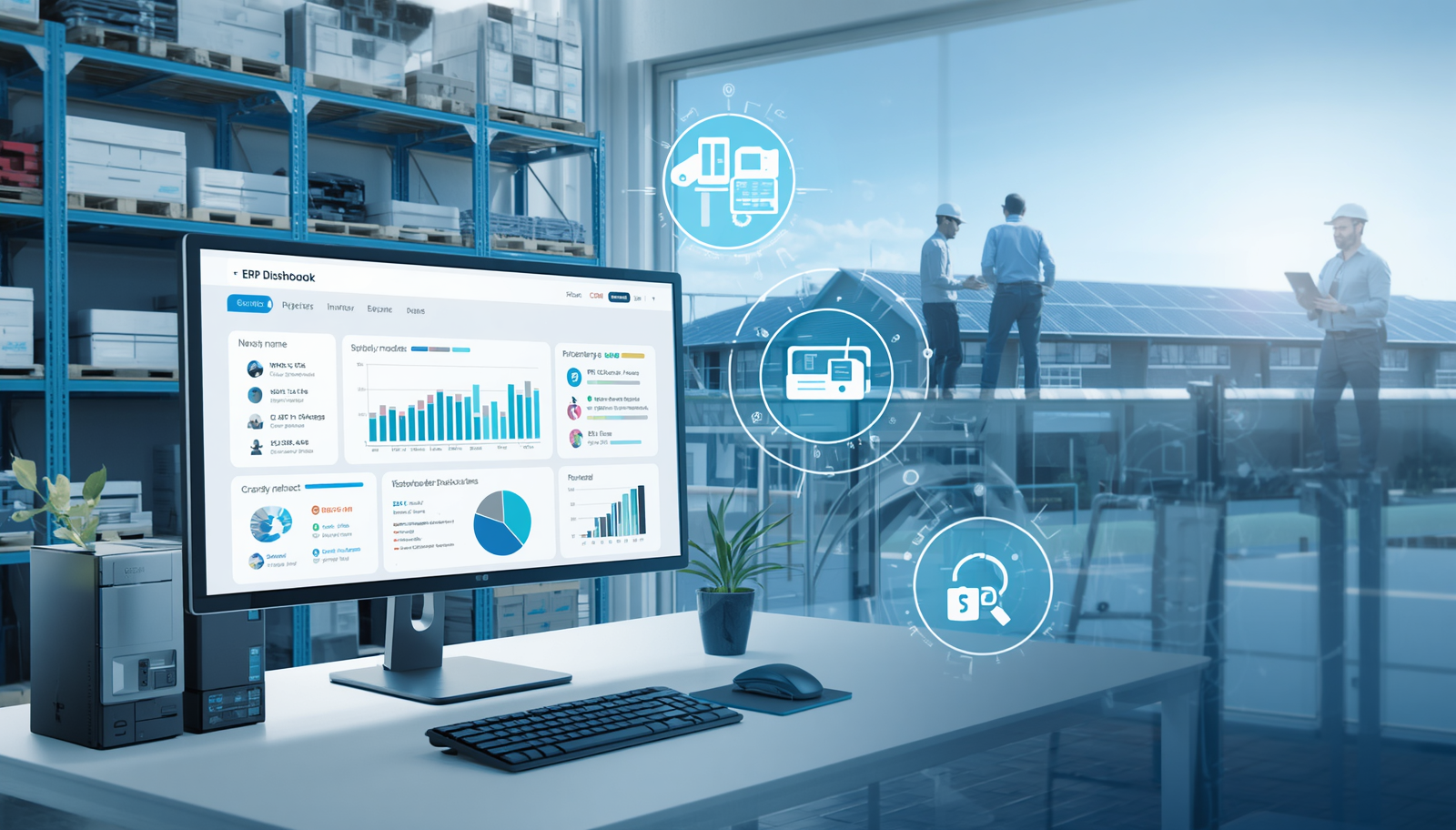
The solar industry has become a national phenomenon in Pakistan. As per 2025 data, the country’s total electricity generation from solar power sources has exceeded 25%, with a total of over 5.3 GW of rooftop installations. In merely two years, the sector has expanded by almost one order of magnitude, and the demand for it seems never to flag. The fact that solar companies are experiencing this explosive growth adds complexity to their operations. Having multiple installation projects, panels, and inverters in multiple storage facilities, sales contracting, and ensuring compliance with taxes. This is where solar ERP software Pakistan by Hisaab.pk can prove to be more than just useful; it can be indispensable.
Challenges in the Solar Industry
The operational challenge that solar companies face in Pakistan is huge. One of the biggest challenges faced by solar companies in Pakistan is the operational one.
In the typical solar installation business, there are far more elements than just panels and wires. A team could be talking to a residential customer in Lahore, sourcing batteries from a supplier in Karachi, having an active commercial installation in Islamabad, and following up on a previous project in Lahore for payment, all in one day.
This means disjointed spreadsheets, separate billing systems, manual stock taking, and a lack of real-time insights into the true state of the business if there’s no system in place. These gaps can add up quickly as projects increase in size, potentially resulting in frustrating customer interactions, billing inaccuracies, stock shortages, and late project installations.
Solar projects management software Pakistan can address this issue by integrating all the departments, such as sales, procurement, warehouse, field teams, and finance, in one single real-time platform.
Impact of ERP For Solar Company
1. End-to-End Project Tracking
Each solar installation is a project with its own timeline, team, budget, and deliverables for the solar company. ERP for solar company operations gives a special project module that tracks all the work, from initial site survey to the final commissioning, in a single place. Project managers can assign tasks, track progress, establish milestones, and receive immediate updates on any task delays.
This is particularly important for EPC (Engineering, Procurement, and Construction) companies that are responsible for huge commercial or industrial solar projects. Real-time dashboards provide you with insight into the project progress, at-risk projects, and project financials without sending one follow-up email to your field team.
Solar companies will see a variety of stock: panels, inverters, batteries, mounting structures, cables, and accessories. Trying to do this on a number of storage locations, or even better, trying to track what has been installed in which location, manually, is a recipe for costly mistakes.
ERP for solar installers provides a robust inventory management module, which is capable of managing items using lot and serial numbers, real-time monitoring, and updating material quantities as they are shipped to job sites. If the stock level drops below a certain level, the system sends out purchase orders; therefore, no more delays because of missing components.
Direct shipments to the site from vendors are also possible in the ERP, which minimizes delivery lead time and warehousing costs for urgent installations.
2. CRM
There is a lot of competition in the solar market in Pakistan. Residential customers get several quotes, and commercial customers will negotiate long-term contracts. An efficient solar ERP software Pakistan also features the CRM (Customer Relationship Management) module, which keeps track of each of the leads from the very first inquiry to the signed contract.
3. Accounting and Financial Control
The income of solar businesses is complicated. Often, payments are made in stages, related to the milestones of the project, such as an advance on signing, part payment on delivery, and the remaining balance upon commissioning. Keeping this up to date and accurate with project costs and overheads is time-consuming and prone to error.
Accounting software for solar service provider can automate their invoicing, follow up on payments based on milestones, estimate project profitability, and produce financial statements in real-time. Compliance risks of sales tax paid and purchase tax receivable are minimized because they are calculated automatically. The platform can also be integrated with Pakistan’s digital invoicing needs and ERP, which will mean that every transaction is properly documented for the business that has been registered with the FBR.
4. Purchase and Vendor Management
Solar firms rely on dependable suppliers for electrical components, solar panels, and inverters. An ERP system revolutionizes procurement by allowing you to send out requests for quotations to several vendors, compare pricing, and then provide purchase orders, all within the system itself. Vendors can be evaluated in terms of delivery time, quality, and pricing, and over time, develop a reliable supply chain.
The multi-level approval process of purchase orders keeps you in control of the financial aspects of your business even as it grows.