

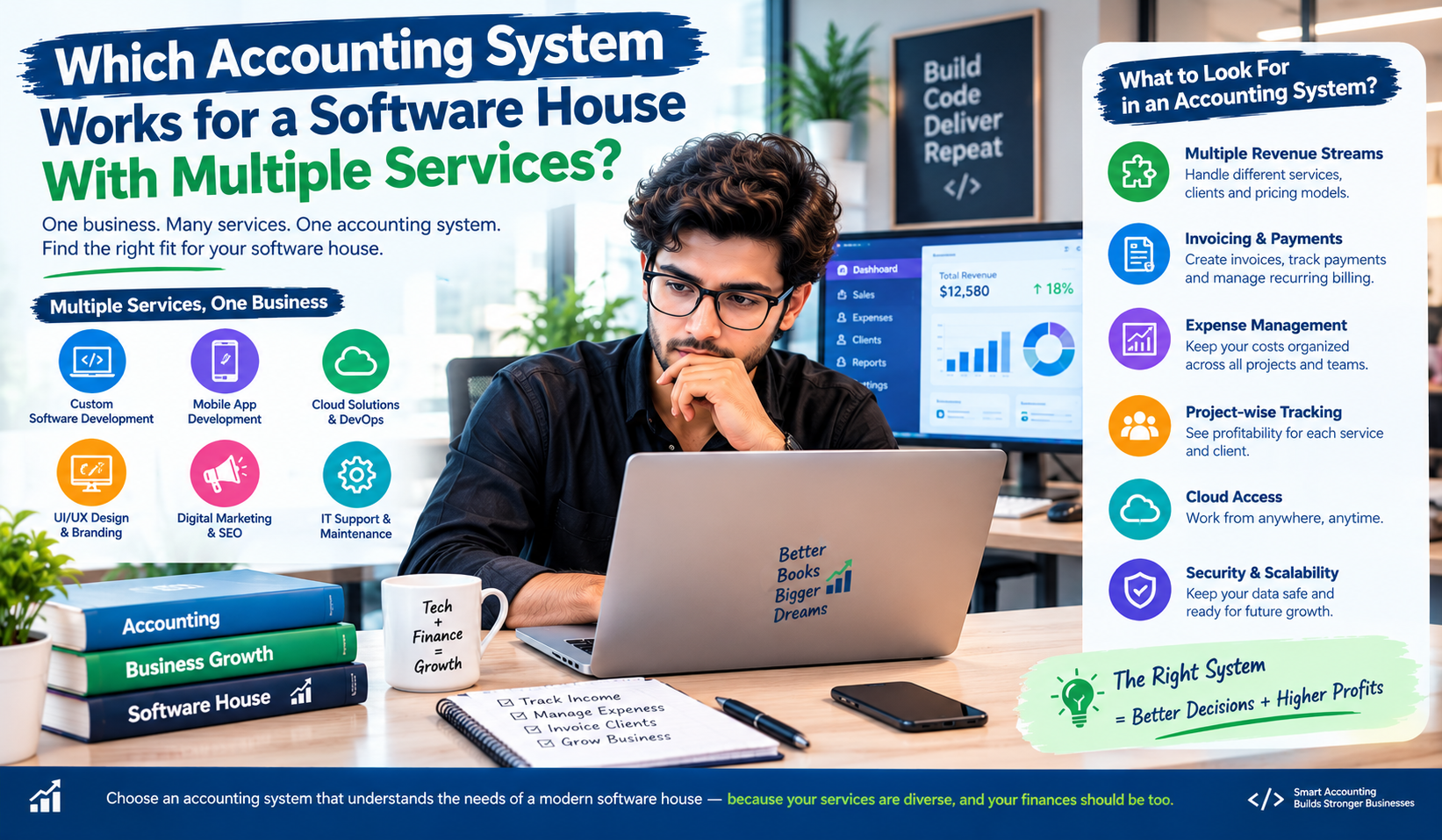
A software house rarely sells one thing. There is project work billed against milestones, a handful of monthly retainers, hosting and licences resold at a margin, and often a marketing service attached to the builds. Each of those earns money differently. That is the point where invoicing software stops being enough and an accounting system becomes necessary.
Why accounting software for a marketing agency and for a software house looks the same
The two businesses sell different work and run into identical accounting problems. Both bill some clients monthly and others by project. Both carry staff cost as their main cost of delivery. Both handle money that belongs to the client, whether that is an ad budget or a hosting renewal. Any system that suits one of them properly will usually suit the other, and any system that only raises invoices will fail both.
The real problem is revenue recognition, not invoicing
Any tool can raise an invoice. The harder question is when the revenue is actually yours.
- Fixed price projects. Earned as the work progresses or at agreed milestones, which means delivered but unbilled work sits on your books as work in progress.
- Monthly retainers. Usually billed in advance and earned across the month, so the unearned portion is a liability until the service is delivered.
- Time and materials. Earned as hours are logged, which only works if timesheets feed the ledger rather than living in a separate sheet.
- Resold hosting and licences. Often the only line where billing and earning happen at the same moment.
A system that treats all four the same will give you a revenue figure that moves with your invoicing habits instead of your delivery.
One client, two billing models
Mixed service lines are now the norm rather than the exception. A software house that builds online stores usually ends up offering ecommerce seo in pakistan as a follow on service, billed monthly against a store that was billed as a one time project. One client, two revenue models, two recognition rules. If the system cannot hold both against the same client account, the work moves into spreadsheets and the ledger stops being the source of truth.
Pass-through costs are the most expensive mistake
When a client’s ad budget or a third party licence runs through your bank account, booking the full amount as your revenue inflates turnover and destroys every margin you report. The question to settle is whether you are acting as principal or as agent. If you are simply passing money through, only your fee is revenue and the rest is a receivable and a payable moving in opposite directions.
Businesses that get this wrong usually discover it at tax time or during due diligence, when a healthy looking turnover turns out to carry a margin nobody can explain.
What multiple services demand from the system
- Project and client dimensions. Every entry taggable to a project and a client, not only to an account code.
- Deferred and unbilled revenue. Schedules that release retainer income monthly and hold delivered work that has not been invoiced.
- Project costing. Billable staff time, subcontractor cost and project tools allocated to the work that consumed them, with administrative salaries left where they belong, in overheads.
- Multi-currency. Export invoices recorded at transaction rate, with remittance evidence tied to the invoice it settles.
- Compliance. Local invoicing in the format the tax authority requires, including FBR digital invoicing where it applies to your business.
- Payroll integration. So that the same salary cost appears once in payroll and again against the project it was spent on, without anyone rekeying it.
Why project profitability is the actual deliverable
A company level profit and loss tells you the year went well or badly. It will not tell you that your retainer clients are quietly subsidising fixed price projects that ran over, or that one long running account has consumed more developer hours than it has ever paid for. That answer only appears when cost and revenue both carry the same project tag.
Most service businesses already suspect which accounts are unprofitable. Very few can prove it, which is why those accounts survive another renewal.
Where to start
If you are comparing options, look at how each system handles retainers, work in progress and project level reporting before you look at price. Hisaab is configured for exactly this pattern, whether the setup is for software houses running mixed project and retainer work, or for service teams billing recurring monthly scopes.
The same structure applies to agency work, which is why our configuration for accounting software for a marketing agency overlaps closely with what a multi service software house needs.
Frequently asked questions
Can one system handle both project billing and monthly retainers?
Yes, provided it supports deferred revenue schedules and project level tagging. Systems built purely around invoicing usually cannot, because they treat the invoice date as the revenue date.
How should client ad budgets be recorded?
Decide whether you are principal or agent on that engagement. If the money is passing through, only your fee is revenue. Recording the full budget as turnover overstates revenue and understates margin.
What reports should a software house or agency review monthly?
Project profitability, unbilled work in progress, deferred revenue balance, receivables ageing by client and utilisation of billable staff.
Does a service business need inventory tracking?
Rarely for stock, but resold licences and hardware behave like inventory and should be tracked so that cost and revenue land in the same period.