

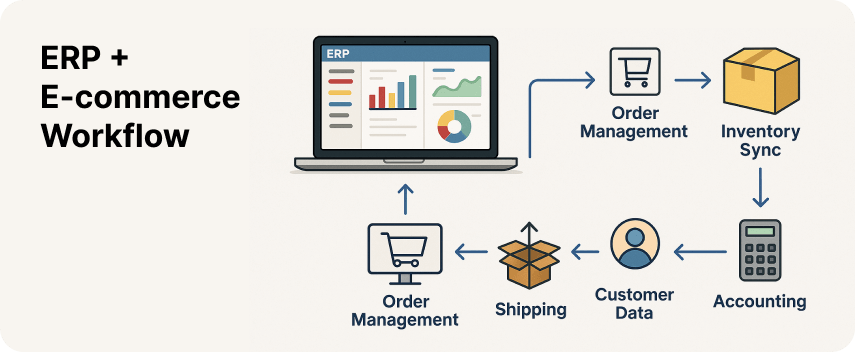
Running a successful eCommerce business is fun until the time of taxation. With the monitoring of hundreds of transactions per day, matching payments between various gateways, inventory expenses, and profit margins, most online store owners are overwhelmed by spreadsheets. The old system of manual accounting can not possibly keep up with the pace of electronic business. This is where ERP accounting software for eCommerce comes in and turns a jumble into a coherent whole, which provides a single solution and automates the process of managing finances between the sale and the reconciliation process.
Complicated Online Store Finances
In contrast to offline companies, eCommerce activities have to deal with several sources of revenue at the same time. One of such orders could include payment gateway fees, shipping fees, commissions to the marketplace, and refund administration. In the absence of appropriate systems, it would be not only useful but also necessary in managing online store finances using ERP software. Spreadsheets are bound to fail as the transaction volume increases, causing costs to be missed, wrong profit calculations, and expensive errors in tax filing.
Advantages of ERP Accounting to eCommerce
● Automated Transaction Categorization
Automation is the most direct advantage of the implementation of ERP. Contemporary systems are linked to a payment gateway, bank accounts, and eCommerce systems, which draw all transactions into a central registry. The ERP automatically labels every sale as revenue and every fee as an expense. This is an automated accounting of online stores that saves dozens of hours a month and reduces human error.
● Real-Time Financial Dashboards
ERP software has live dashboards displaying major metrics: the current cash balance, outstanding payables, pending receivables, and, most importantly, profitability. Business owners are no longer required to wait till the end of the month before they can have a clue about their financial status. They can have a glimpse at the overall margins by the effect of today’s sales with a few clicks.
● Track Profit and Loss
The core of any eCommerce business is its profit and loss tracking. You do not know which products actually make a profit after all expenses, and cannot make informed decisions regarding pricing, marketing expenditure, or even ordering of inventory. ERP software does a great job of offering profit and loss tracking visibility.
The strong ERP divides profitability into various dimensions. Those detailed information unveils information that the aggregate reporting conceals.
How to Track eCommerce Revenues and Expenses with ERP?
To comprehend the issue of how to track eCommerce revenue and expenses with ERP, it is necessary to be familiar with the streams of finances to be tracked. The following is what an ERP should automatically monitor:
- Revenue Tracking: All the sales, gross sales, discounts offered, promotional adjustments, and refunds made. The ERP divides revenue based on payment method, geographical region, and sales channel.
- Direct Expenses: Cost of goods sold (purchase costs of product or manufacturing costs), shipping costs, packaging costs, and payment gateway fees. These costs directly decrease gross profit.
- Indirect Expenses: Each month, the subscription fee to the platform, marketing expenses (PPC, influencer payments), rent, salaries of employees, software subscriptions, and utility costs. These overhead costs affect net profit.
- Operational Metrics: Average order value, customer acquisition cost, inventory turnover rate, and days sales outstanding. Such metrics are used to make strategic decisions that are not just about basic accounting.
Inventory and Financial Integration
A bridge between the inventory control and accounting is one of the benefits of ERP systems that is often neglected. Each time you buy stock from a supplier, the ERP makes an accounts payable record. The system will automatically compute COGS and decrease the value of the assets in your balance sheet when you sell that inventory. This combination will make sure that your profit margins are never based on estimated averages.
In the absence of this relationship, most eCommerce businesses are inaccurate in calculating gross profit as they rely on old or estimated COGS values. This guessing game is completely eradicated by an ERP.
Tax Compliance and Reporting
Records that are required by tax authorities must be accurate and auditable. An ERP accounting system produces detailed reports of profit and loss statements, balance sheets, statements of cash flows, and tax summaries that meet the requirements of the regulator. In the case of Pakistani eCommerce businesses, this implies that sales tax returns and income tax evaluations must be documented. Automated audit trails will indicate the origin and any alterations of each transaction, giving it transparency that cannot be compared to manual books.
ERP Solutions: How to Select the Right Solution.
Not all ERP systems suit eCommerce needs. Find solutions that provide native integrations with your sales platforms (Shopify, WooCommerce, Daraz), payment gateway, and banking partners. Online businesses can find cloud-based ERP systems especially useful since business owners can view financial information anywhere, work with remote accountants, and expand the system as the number of transactions increases. Hisaab.pk is one of the best options that fulfill all of these requirements of ERP accounting software for eCommerce.