

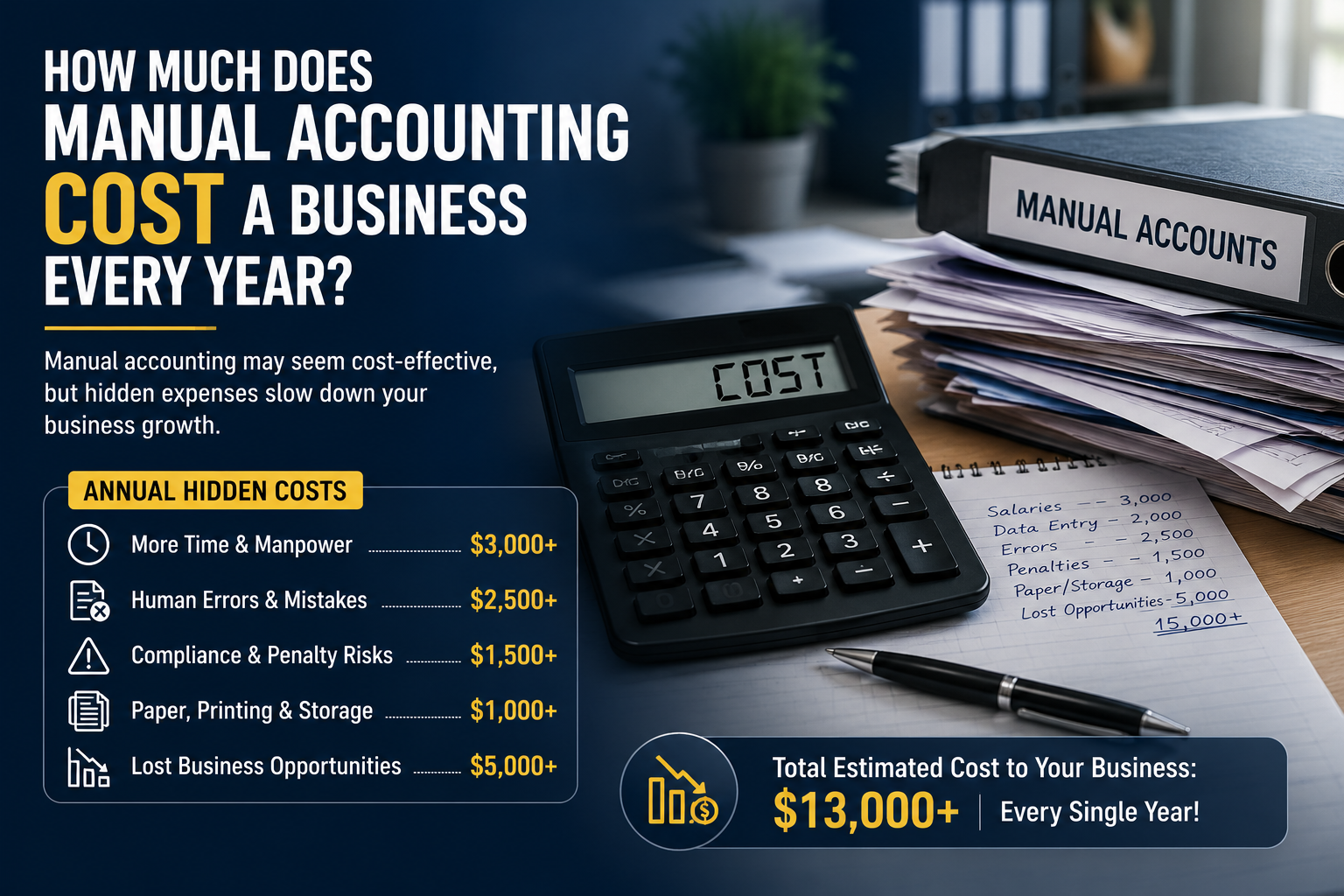
Manual accounting is seen by many business owners as a cheaper option than software, as they do not need to buy software. It might appear to be a cost-effective solution at first glance to record transactions in a spreadsheet, paper ledgers, or handwritten books. The cost of manual bookkeeping may be more insidious however, in lost productivity, high priced mistakes, delayed financial reporting, and lost business opportunities.
These inefficiencies are more apparent as businesses expand. At first glance, it may seem like the answer is a low-cost system, but it can ultimately waste precious time and resources. The Hidden Cost of Manual Accounting is one of the reasons why businesses all over the world are moving towards digital accounting solutions, and it’s likely to be a growing trend for Accounting software in Pakistan among startups, retailers, wholesalers, and manufacturers.
Hidden Cost of Manual Accounting
Manual accounting comes with more than a price tag of stationery or record books. This encompasses all time that employees dedicate to manually entering data, correcting errors, looking for papers, reconciling accounts and making financial reports.
The most prevalent hidden costs are:
- Time spent re-entering data over and over.
- Late invoice and financial reporting.
- Reduced staff morale and productivity from time-consuming bookkeeping.
- Difficulty finding historical information.
- Manual bank statement reconciliation.
- Loss of productivity associated with audit and tax preparation.
- Higher administrative overhead.
Taken individually the tasks are all small, but when combined, they can eat up hundreds of work hours annually.
Manual Accounting Mistakes Can Be Costly
Manual accounting mistakes can happen to even seasoned accountants. Manual calculation of journal entries, calculations and reconciliation is prone to human error.
Some general accounting mistakes are:
- Incorrect data entry.
- Duplicate transactions.
- Missing invoices.
- Miscalculated taxes.
- Incorrect account balances.
- Lack of receipts or supporting documentation.
- Incorrectly recording transactions in the wrong accounts.
Such errors may result in incorrect financial statements, late tax filing, cash flow issues and bad business decisions resulting from inaccurate financial data. These errors may need more employee time to correct, further driving up the cost of operation.
Cost of Lost Time
One of the most important assets of a business is time. Manual accounting involves repetitive administrative tasks which can be automated.
For instance, an accountant can devote several hours a week:
- Recording sales transactions.
- Matching payments.
- Preparing invoices.
- Reconciling bank statements.
- Updating inventory records.
- Generating financial reports.
These common jobs can take hundreds of hours throughout the year. Those hours can be allocated to financial planning, customer service, business development, or strategic decision-making, among other things.
Delayed Financial Decisions
Having precise financial data is crucial for well-informed business decisions. Companies using manual processes may have to wait days, if not weeks, for the reports to be ready. If owners don’t have the financial information in real time that can delay important decisions which can impact profitability and business growth.
How Much Money Can Accounting Software Save?
The savings are in several measurable areas, and can be as much or as little as a business might choose.
Businesses can save money by using accounting software, which can:
- Minimizing manual data entry.
- Automating invoice generation.
- Simplifying bank reconciliation.
- Minimizing accounting errors.
- Efficiently preparing tax returns.
- Reducing paperwork.
- Improving inventory accuracy.
- Decreasing administrative workload.
- Creating real-time financial statements.
Even a minor saving in administrative time can mean a big saving of hours or days a month for businesses that process hundreds or thousands of transactions monthly, and more hours or days saved a month could mean thousands of dollars saved a year.
Further, the fewer the errors, the less the expense of record correction, dispute resolution and penalties resulting from improper reporting.
Why Is Accounting Software Becoming A Choice For Businesses In Pakistan?
The trend of using Accounting software in Pakistan is escalating as the business need for efficient financial management is gaining momentum. Whether it’s for a small retail store, restaurant, or manufacturer, distribution companies are all transitioning away from traditional bookkeeping methods and toward automation. This is where hisaab.pk comes in and provides you with any accounting software you require. Most of the modern accounting software has the following facilities:
- Automated bookkeeping.
- Sales management and buying and selling.
- Inventory tracking.
- Payroll management.
- Tax calculations.
- Bank reconciliation.
- Financial reporting.
- Multi-user access.
- Secure cloud backups.
These elements cut down on administrative burden and enhance the precision and ease of access to financial information.
Role of Accounting Software in Reducing Accounting Costs
One of the primary benefits of automation is that it can eventually save on accounting expenses. Rather than adding to the workforce to handle higher volume transactions, businesses can rely on software to handle repetitive transactions. By making use of accounting software, costs can be reduced in the following ways:
- Preventing data duplication.
- Minimising the use of paper records.
- Reducing month end closing cycle.
- Reducing the chances of expensive accounting errors.
- Improving employee productivity.
- Minimizing audit preparation time.
- Reducing storage and document management costs.
This means finance teams can now get on with analysis and planning instead of doing administrative work.