

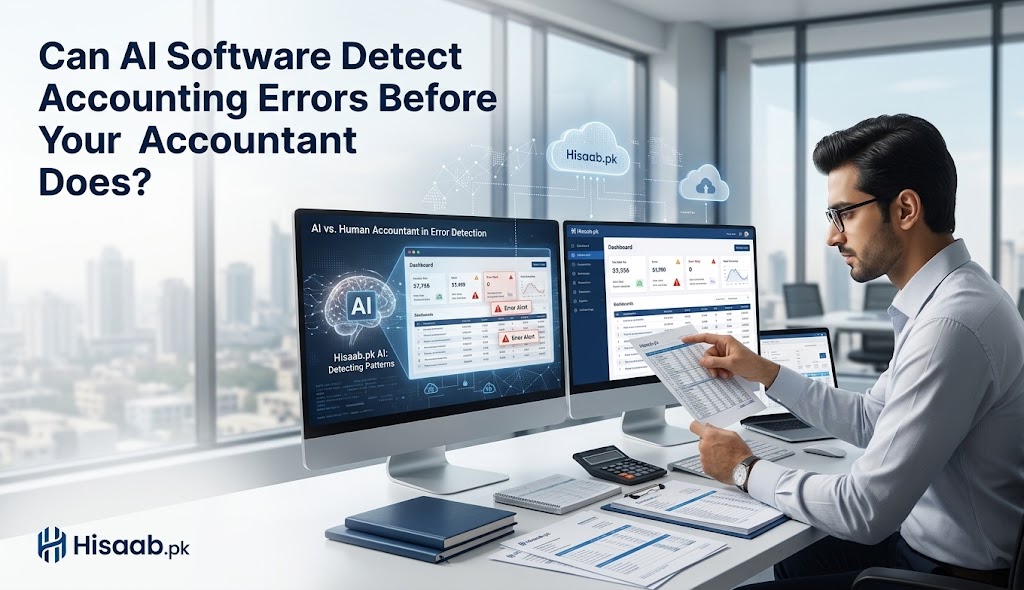
If the payment is duplicated, an unusual journal entry, or if the expense is misclassified, nothing will be noticed until month-end review. That becomes increasingly important as businesses make more and more transactions. Financial data is continuously analysed using AI to identify patterns that require attention and to prioritise for human review. Studies have demonstrated that machine-learning techniques can be employed to identify accounting misstatements when they are merged with the information present in the audit, governance and market. Self-supervised learning and neural networks are being tested in recent research for anomaly detection.
What is an accounting error?
It’s important to differentiate errors from fraud and normal business fluctuation before making the question of whether AI can discover an error. It’s also important to distinguish mistakes from fraud and regular business variation prior to asking whether AI can identify an error. An accounting error can include incorrect amounts, posting to the wrong account, an incorrect duplicate invoice, or a reversal of a debit and credit, or the incorrect period. An anomaly is more general; it’s a transaction or pattern which is significantly different from what is expected by a system. Therefore, it’s not proof of an error, it’s a warning.
Many issues are already detected using traditional accounting controls. Reconciliations are a comparison of records to bank statements, invoices, and subsidiary ledgers. Approval workflows limit who can approve transactions and accountants review any unusual balances and investigate any discrepancies. When integrated with AI, this can further analyze numerous transactions and look for connections that might not be apparent from a human perspective.
How AI helps detect accounting mistakes?
AI accounts for errors usually by using pattern matching. A model can be trained to recognize the ‘normal’ activity of transactions, including the typical number of amounts paid, vendors, timing, account combinations, and/or posting frequencies. If a new transaction does not conform to those patterns, the system can assign a risk score to the transaction, or alert the user.
This will help you understand how AI helps detect accounting mistakes without taking the place of accounting judgement. Let’s assume a company uses a supplier, and that supplier bills them at a fairly consistent price each month, and one month there is a bill that is significantly higher, and that bill arrives just before another bill. The sequence might be detected by a detection system. Also, if the same invoice number is used more than once, unusual account combinations, unexpected postings on the weekend or unusual expenses patterns may warrant investigation.
Benefits AI in Accounting
Benefits AI in Accounting goes beyond identifying individual mistakes. Routine transactions can be automatically screened and the time spent on that is reduced, allowing accountants to focus on exceptions and higher value analysis. When designed appropriately, AI can help expedite reconciliations, document processing, forecasting and tracking fraud risks too.
But accuracy is accomplished only in the context of data quality, model design, and data context. An unusual transaction may appear suspicious, or an error may appear to be a normal transaction. Research on AI accounting error detection is thus focused on false alarms, interpretability, as well as evaluating models using real financial data, not just by headline accuracy.
Is AI good enough to replace an Accountant?
An anomaly could be identified by AI before an accountant would see it; especially when the data set is large and the anomaly occurs across thousands of transactions. But it doesn’t mean that AI is automatically superior in accounting. The context, policies, evidence, materiality, and professional responsibilities of business are understood by accountants. AI is most useful in the role of an early warning system and as the final judging voice for the accountant.
It is crucial for businesses to consider AI accounting software Pakistan, particularly in a human-in-the-loop scenario. A system should provide an explanation of the reason for the flagging of a transaction, a record of the audit trail and the ability for authorized parties to review and correct any records.
What should businesses be looking for?
To compare accounting software in Pakistan, consider the software’s automated checks, audit trails, role-based controls, reconciliation support, data security, and clear alerts. If AI is incorporated, ask what information is used, what happens if the AI gives you a false positive, can users see the evidence, and how are models monitored after being implemented?
The solution is NOT accountant versus AI. It’s accounting and technology. Finance personnel can make the judgment calls to determine if an alert is an error, legitimate exception or a possible fraud, while AI can continuously process a volume of transactions that can be impractical for people to handle.
It’s obvious: AI can identify signals sooner but it cannot ensure that every single accounting error will be uncovered. Anomaly detection can be an extra step in financial oversight when implemented alongside reliable accounting records and robust internal controls, aided by governed AI systems.