

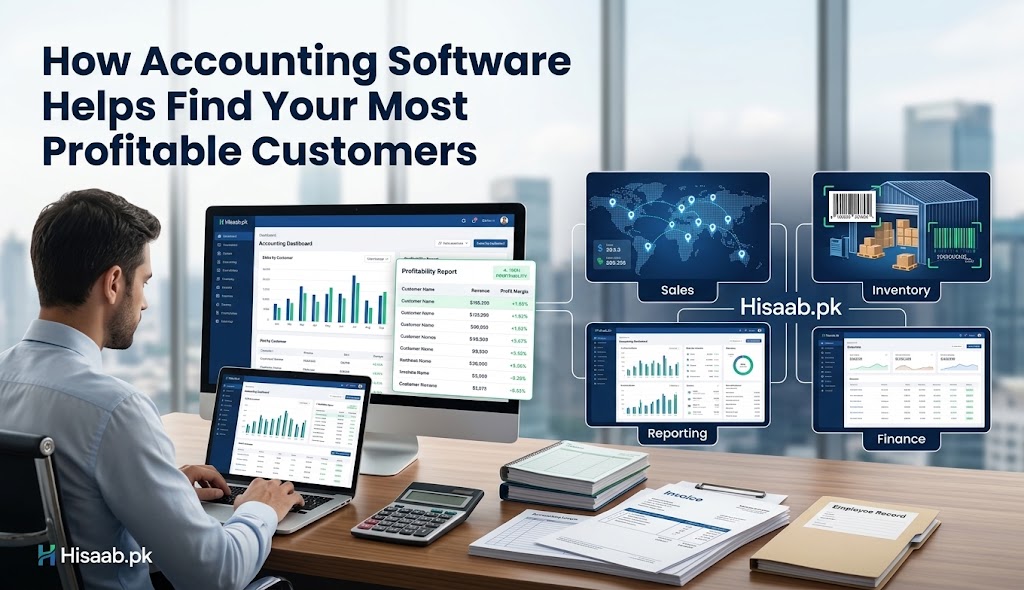
A customer who makes money could seem important, but the number of dollars does not tell you what a company makes from a customer. A big order might require the buyer to have frequent deliveries, discounts, returns, technical support or a longer payment period, all of which take resources away from the margin. In the modern accounting system, sales, costs, receivables, customer information, etc. can be linked, and the transactions scattered throughout the system can be consolidated into evidence for better business decisions. That isn’t about to be an educated guess based on sales volume; it’s a practical management question.
Understanding Customer Profitability with Accounting Software
● Profitable Customer Analysis
The bottom line of the foundation is profitable customer analysis. The revenue generated by a single customer/segment and the cost to serve that segment. From linked records, accounting software in Pakistan can determine costs of goods sold, taxes, payment fees, delivery charges, and outstanding balances, among other factors, from sales totals. This provides a more true to life view of contribution. The Harvard Business School work on activity based costing has always been about linkage, namely the linkage between the cost of serving an account and the margin they generate.
● Customer Sales Analysis
There is a further layer on customer sales analysis. While annual revenue is one thing to consider, businesses can also see purchase frequency, the average order value, product mix, discounts, returns, payment behavior and trends over time. A customer who buys high-ticket items at full price could be more desirable than one who makes two times the sales by buying low ticket items at a discount. Similarly, a customer whose payments are made on time may be worth more to a business than a customer who is often late with their payments and therefore is using working capital.
How to identify profitable customers?
● Customer Dataset
The first step is to create a consistent data set for customers. Attach each invoice to a customer account and add discounts, returns, direct product costs, delivery fees, commissions and any identifiable service costs. Then, use gross or contribution margin, not sales, to calculate. Schedule special customer services like urgent deliveries, customer support calls, or high frequency orders when possible. Activity based costing can help uncover these hidden differences in cost to serve.
● Segmentation
Financial dashboards can sort and rank customers by revenue, gross margin, contribution margin, outstanding receivables, order frequency and profitability trend. A two-dimensional perspective can be more useful than a scorecard: One dimension along revenue, the other dimension along margin. High revenue / low margin customers should be investigated, lower revenue but consistently high margin accounts should be given more attention.
Financial Reporting Software Link with Customer Profitability
These analyses can be repeated using financial reporting software. Customer profitability reports can be scheduled instead of combining spreadsheets manually at month end, and can be compared by period, branch, product or by salesperson. Integrated systems can also be linked to customer performance, enabling managers to identify profitable customers from those who create a chronic problem with their sales.
But financial reporting software doesn’t guarantee 100% profitability. Making valid assumptions is crucial to cost allocation and past profits are no guarantee of future profits. There are times when a customer may be unprofitable in the short term due to their ramp up costs, but become profitable in the long term, and vice versa, a customer that has historically been profitable may turn unprofitable after a price adjustment. Profit needs to be viewed in tandem with retention, strategic value, growth potential, payment risk and customer value.
In an advanced business, reporting and business intelligence becomes more than the past, the more future-oriented and predictive, the better. With reliable transaction histories, analytics models can determine when someone is purchasing less or when their preferences in products are shifting, or whether their transaction history reflects poor payment habits. This will enable managers to plan specific actions, such as adjusting prices, lowering unprofitable service demands, providing appropriate products, changing terms of payment, or increasing the investment in high-value accounts.
The objective isn’t to classify customers as “good” or “bad. It is important to understand the economics of each relationship, and make decisions on pricing, service, retention, and resources allocation. The study on activity-based management has highlighted the importance of linking operational activities to customers’ costs to aid in better decisions in strategy. The same concept can apply to small businesses in Pakistan, starting with tidying up customer records, precise costs, seamless invoicing, and transparent monthly reports.
This approach helps decision makers not to make a mistake by mistaking profitability for cash generation. A customer may be able to display margins whilst also having receivables, placing liquidity stress on the company. When viewing profit, payment timing and service cost in the same league, the resulting review is comprehensive and can help guide decisions that are based on accounting performance and reality.